What about Fear?
THE STORY
A client asked me something this week that I think about often. She is on the edge of changing jobs, the kind of decision that takes months to work up to, and she paused and said,
“What if I go through all of this work to change jobs, and nothing gets better?”
It is such an honest question. And underneath it is something every one of us has felt before a hard decision. The fear is not really about the job. It is about whether the effort will have been worth it.
Here is where reframing becomes powerful. You do not get to choose whether fear shows up. But you do get to choose where you put your attention once it does. You can stay with, “What if it is worse, what if I fail?” Or you can gently shift toward, “What if it turns out okay?”
Neither question has a guaranteed answer. But one of them lets you keep moving.
THE INSIGHT
Most of our fear is mental projection. It is not happening. It is a story about what might happen, built from a question that starts with “what if” and ends somewhere negative or even painful.
In medicine and healthcare, this shows up in familiar disguises:
• If I miss something, I could harm someone.
• If I do not have the answer, I will lose credibility.
• If I ask for help, my colleagues will think I am inefficient or lazy.
• If I rest, I will miss something important.
• If I set a boundary, I will not be seen as a team player.
Underneath nearly all of it sits the same dread, the fear of failure. And underneath that fear, three quieter worries are usually at work.
• Loss. What will I lose if this goes wrong?
• Process. Change is difficult - is it worth it?
• Outcome. What if it simply is not better?
This is not a flaw in your thinking. It is a pattern, often shaped by perfectionism, by a fear of shame, and by a sense that a mistake might unravel your identity rather than simply be a mistake.
“Failing is an action. It is not an identity.”
THE TOOL
Try running a fear through the Thought Model. It only takes a few minutes, and it shows you exactly where you have room to move.
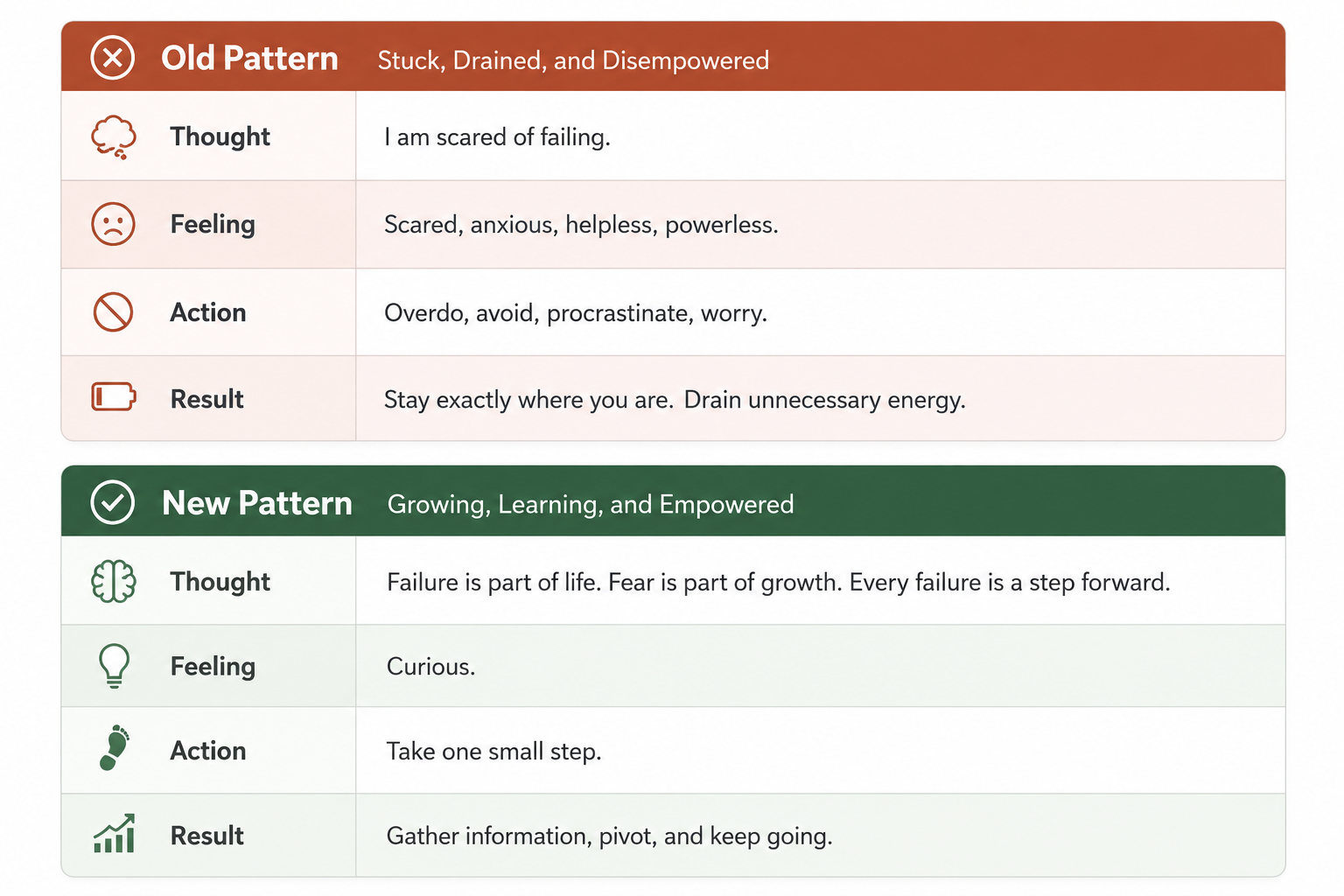
THE ACTIONS
Fear is not a problem to solve. It is energy to work with. Here is how you can approach..
Start small. You do not need a five-year plan to take one small action. Pick the smallest possible step, take it, and let the success build momentum for the next one.
Focus on what you can control. You cannot control the outcome - really, you can’t. You can control your preparation, your effort, and your next action. Put your energy there.
Make a plan for failure. Ask yourself, if this does not work out, what would I do next?Having an answer, even a rough one, quiets the fear more than avoiding the question ever will.
Reframe failure as information. Every misstep teaches you something the success would not have. Ask, what did I learn here? That question turns failure into forward motion instead of evidence against you.
Separate the outcome from your identity. Failing is an action. It is not who you are. The moment you stop needing every attempt to succeed in order to feel capable, fear loses most of its grip.
Celebrate the small win. Did not get the whole outcome you wanted? Notice what did move forward. That recognition is what keeps you going long enough to get where you are headed.
REFLECTION QUESTIONS
• What am I actually afraid of losing? How likely is that to happen?
• If I failed at this, what would I do next? Having a plan tends to quiet the fear.
• What is one small step I can take today, separate from the outcome?